
How a Workshop Unfolds
After a brief introduction, we begin by listening to Annabel perform a piece of music on the piano. The question is: What happens within you as you listen to this music? Do you feel an urge to move, or perhaps to tap the beat with your fingers or foot? Does your pulse increase—does your heart beat a little faster? Do you sense discomfort, joy, or perhaps sorrow? What happens in the mind, in your thoughts? Do images appear, or do you see colors? Does the music remind you of something—or of someone?
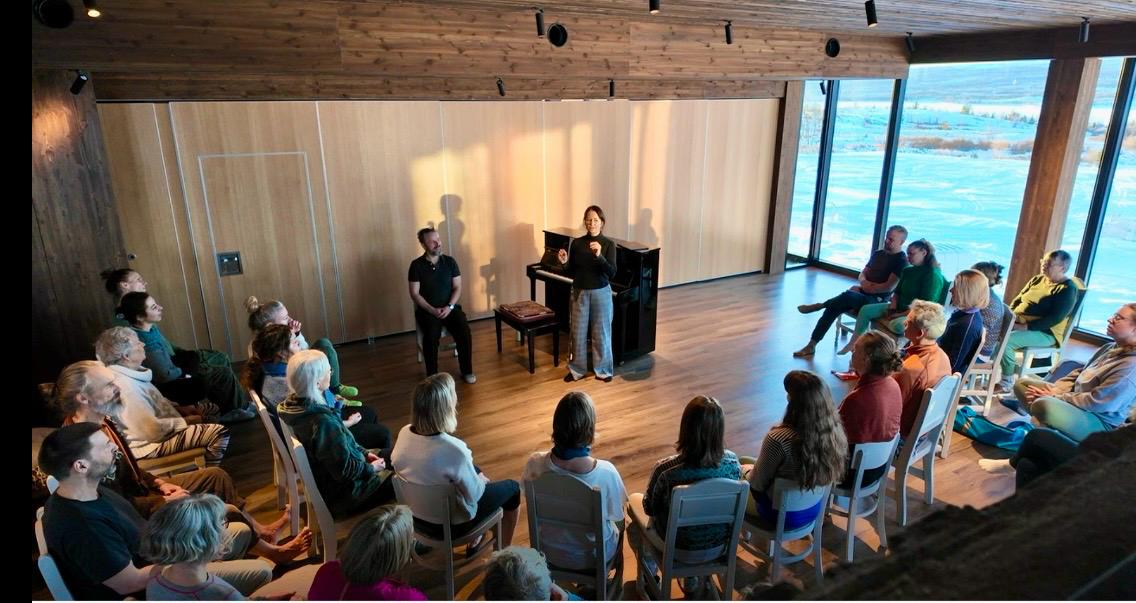
Music can take us back to forgotten times and awaken old emotions that have become lodged within us, breaking through their encapsulation and touching something that was once tender or painful. There is no right or wrong answer.
When the music fades away, we invite participants who wish to do so to share their experiences in a round of reflection. This approach is known as embodied cognition, in which knowledge and understanding are not viewed as something that happens only in the mind, but as something that emerges through the interaction of body, senses, emotions, and environment.
When we share experiences in the reflection round, the aim is not to arrive at a shared interpretation, but to acknowledge the diversity of bodily responses. Each participant’s experience is valid, because music always encounters a lived, sensing human being.
We then follow Annabel as “Lyttelos” (Listener’s Pilot) into the same musical work and explore its dramaturgical structures and timeless phenomena such as tension and release, past and future. The question now shifts from What happens in me? to What happens in the music?
Next, Piotr leads a 20-minute meditation focusing on breath, acceptance, and integration. This flows seamlessly into a new performance of the same musical piece. In the final reflection round, participants are invited to share whether they experienced the music differently this time.
Our Methods
Embodied cognition is about becoming aware of what happens in the body in the encounter with music—a bodily mode of interpretation in which experience precedes concepts. In relation to music, this means that listening is not primarily about analysis or interpretation, but about noticing how the music affects the body here and now—through breath, tension, pulse, movement, inner images, and affect. The body becomes a listening subject, not merely a receiving apparatus for sound.
Through musical phenomenology, one seeks to discover the music as it appears in the moment, without adding explanations, associations, or judgments. The focus lies on time, movement, tension and release, sound and silence, as they are actually experienced. Annabel has been engaged with this musical approach for over 30 years. Her mentor was the Spanish conductor Jordi Mora, who in turn studied with Sergiu Celibidache. This tradition places great emphasis on presence, non-goal-oriented listening, and a deep respect for the unique character of the moment. The approach has clear connections to Zen Buddhism, particularly through its emphasis on non-striving, attentiveness, and experience as it unfolds before language intervenes.
Metta meditation is a Buddhist meditation practice that cultivates kind and benevolent attention—first toward oneself, and then gradually toward others and the world as a whole. Through a simple, guided practice, Piotr invites participants to cultivate a gentle and inclusive attitude toward their own body, breath, and inner experience.
When metta meditation is introduced before listening to the musical piece for the second time, the relationship to the music changes. The music is no longer met with analysis or expectation, but with openness and receptivity. In this way, the meditation becomes a quiet preparation, dissolving inner resistance and expanding the space for experience—allowing the music to emerge as something one is in relationship with, rather than something to be mastered.
Piotr Marcinów is a teacher of meditation and philosophy with a Master’s degree in Indian Philosophy. He is an active participant in yoga conferences and events, where he bridges the gap between academic study and practical experience. He is fascinated by early Buddhist teaching. In The Listening Body project, Piotr is responsible for the meditation practice, creating the space for presence and reflection.